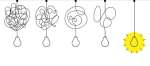
Epigenetics is the study of how the brain responds to physical stimuli of electromagnetic and chemical flow in the brain. This process triggers groups of genes to act in a positive or negative direction based on your emotional and/or physical reactions to life events. Life events plus your response to those events determine the outcomes of your life. Negative responses create negative outcomes, and positive responses drive more positive and optimal outcomes, even in the most challenging of life circumstances.
When you change your behavior, you change your life circumstances… You are free to make choices about how you focus your attention, and this affects how the chemicals and proteins and wiring of your brain change and function. Neuroscientists are proving that the relationship between what you think and how you understand yourself and the world around you – your beliefs, dreams, hopes, and thoughts – has a huge impact on how your brain works and ultimately what you achieve in levels of performance excellence.
The link to neuroscience and thought is that thoughts are real, physical things that occupy mental real estate. Moment by moment, every day, you are changing the structure of your brain through your thinking. When you are thinking positively, productively, and when you hope for something better, you alter the physical structure of your brain in a more positive, productive direction allowing your brain to function in the high capacity for which it is created.
Rudolph Tanzi, PhD, says there are four roles you can learn and manage every day to take control of your thoughts, so you take control of your life:
- Lead your brain – you can give your brain‑specific orders every day
- Reinvent your brain – create new neuropathways and connections inside your brain to become more productive and to achieve your goals
- Teach your brain – train your brain into new habits and new skills
- Use your brain – you are responsible for keeping your brain in good working order.
Your brain is the gateway to your future. Your brain cannot do for you what it thinks it cannot do. Primitive or negative reactions (fear, anger, jealousy, and aggression) to external threat stimuli can overrule higher brain function necessary for higher‑order cognitive function (problem solving, critical thinking, teamwork, unit, clarity, and cohesion). Learning how to create a robust response capacity – mental resilience – you can learn to take control of your thinking and ultimately learn to take control of your destiny.
Learning the skill of Positive Presence, you can learn to take control of your thinking. The skill of Positive Presence is your innate ability to adjust for and create a positive and energized mindset through conscience thought processes that ultimately teaches you to take control of your brain and your destiny.

In December of 2018 my good friend and mentor, Dr. Michael Frisina, was published in the International Journal of Academic Medicine | Volume 4 | Issue 3 | September-December 2018.
So often we hear in leadership education that we are to “lead by example.” Too often this translates to leaders that if I want my employees to work as hard as I do, than that means I have to demonstrate it through my own initiative. Sadly this concept gets oversimplified. When leaders want employees to work longer hours, they think that they set that example by staying at work the longest. The reality is if you really want to impact your workforce and lead by example, start caring for the emotional and physical wellbeing of your people. Start appealing to the hierarchy of organizational behaviours that do exist in your workplace. Start respecting your people, start clearly and effectively communicating with your employees, and start demonstrating to them that their work is creating lasting meaning and has purpose.
In 1943 Abraham Maslow developed what many of us know as “Maslow’s hierarchy of needs.” His theory is that human psychology revolves around a five-tier model of human needs, often depicted as hierarchical levels within a pyramid. As you may know, lower level needs in the hierarchy must be satisfied before individuals can attend to needs higher up. From the bottom of the hierarchy upwards, the needs are: physiological, safety, love and belonging, esteem and self-actualization.
We have all been taught that the key to communication is listening. This is true, but you first must care before you can listen to understand effectively. Effective communication, as a highly influential trust behaviour, requires caring first, and seeking to understand before demanding to be understood. An old adage is applicable here: I do not care in how much you know, until you demonstrate to me how much you care. Displaying behaviour of compassion to another person opens their brain up to a willingness to listen. When people make a decision to shut you out of their lives because of your behaviour, effective communication with those people ceases.
Technology mogul Elon Musk once tweeted out that “people are overrated.” While he would later explain that he was referring to the power of robotics and the emerging technology in both robotics and artificial intelligence, one wonders how destructive that nineteen-character tweet was to his organization? Musk worked diligently to surround himself with really bright and intelligent people that spend a considerable amount of time and energy on his research and engineering projects. Robotics maybe an emerging technology but people are not overrated … and words have meaning; your words as a leader have immense power. Words send a strong message to the people who work with and for you in your organization.
Leadership effectiveness has three key components – not competencies – but system components – the necessary and sufficient conditions to produce results sustainable over time at a very high level. The three core components of leadership are:
There are basically four fundamental aspects of behaviour style: (1) executing (driver), (2) influencing (persuader), (3) strategic thinking (analyzer), and (4) relationship building, (stabilizer). With a fundamental understanding of these four aspects of behaviour patterns and how they affect connection, collaboration, and engagement, we can examine their link to the intrinsic nature of leadership.
There are essentially four behaviour preferences or styles: (1) executing (driver), (2) influencing (persuader), (3) strategic thinking (analyzer), and (4) relationship building, (stabilizer). Having awareness of your dominant behaviour pattern or style as well as others’ behaviour styles is essential in leading your team members to higher levels of performance under times of stress, change, fatigue, increased complexity, and chaos. Our behaviour styles are strengths that connect us to who we are, what we believe, and how we choose to behave.
John Maynard Keyes wrote, “The hardest thing is not to get people to accept new ideas; it is to get them to forget the old ones.” Change, increased complexity, and chaos are constants in our knowledge and technology driven world. Yet, with all of this change, increased complexity, and resulting chaos influential leaders and their organizations continue to thrive. What distinguishes organizations that thrive in the current operational environment from organizations that fail? What distinguishes influential leaders from those who are not leading effectively? A common denominator among successful influential leaders is they have discovered and use their behaviour strengths to propel themselves and their organizations to peak performance.